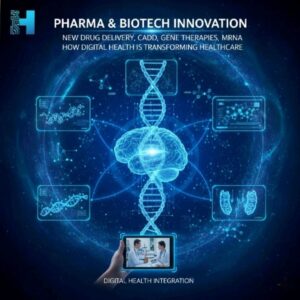
Pharma & biotech innovation. new drug delivery systems, CADD
(computer aided drug design), gene therapies, Mrna.
The pharmaceutical and biotechnology industries are experiencing a paradigm shift driven by digital health technologies. Innovations such as computer-aided drug design (CADD), advanced drug delivery systems, gene therapies, and mRNA-based medicines are transforming how drugs are discovered, developed, and delivered to patients. By integrating artificial intelligence, big data analytics, bioinformatics, and digital platforms, digital health is accelerating innovation while improving treatment precision, safety, and accessibility.
Role of Digital Health in Modern Drug Discovery
Computer-Aided Drug Design (CADD)
CADD uses computational tools, molecular modelling, and AI algorithms to identify potential drug candidates and optimize lead compounds. This approach significantly reduces time, cost, and failure rates in drug development.
Indian Example:
Indian pharmaceutical companies and research institutes are increasingly using CADD platforms in collaboration with biotech startups and academic centers. Organizations such as Biocon and Dr. Reddy’s Laboratories apply in-silico modelling and AI-based screening to accelerate discovery of novel molecules and biosimilars.
Global Example:
Globally, companies like DeepMind (AlphaFold) have revolutionized protein structure prediction using AI, enabling faster understanding of disease mechanisms. Major pharmaceutical companies such as Pfizer and Novartis use AI-driven CADD tools to shorten early-stage drug discovery timelines.
Digital Innovation in Drug Delivery Systems
Smart and Targeted Drug Delivery
Digital health enables the development of advanced drug delivery systems that improve bioavailability, targeting, and patient adherence. Technologies such as nanotechnology, controlled-release systems, and digital therapeutics enhance treatment outcomes.
Indian Example:
Indian research institutions are working on nanoparticle-based drug delivery for cancer and chronic diseases, supported by digital simulation and modeling tools. Smart inhalers and insulin delivery systems integrated with mobile apps are being adopted in urban healthcare settings.
Global Example:
Internationally, smart drug delivery devices—such as connected insulin pens and digital inhalers—are used to monitor dosage, adherence, and patient response. These systems transmit real-time data to healthcare providers, supporting personalized treatment adjustments.
Gene Therapy and Digital Health Integration
Gene therapies involve complex development processes requiring advanced bioinformatics and data analytics. Digital health platforms play a critical role in genomic sequencing, target identification, and therapy optimization.
Indian Example:
India is gradually entering the gene therapy space through academic research and biotech startups using digital genomics platforms. Bioinformatics tools help analyse genetic data for rare diseases and inherited disorders, improving diagnostic accuracy and therapy design.
Global Example:
In the US and Europe, companies developing gene therapies use AI and digital modelling to design viral vectors and predict treatment outcomes. Digital registries and remote monitoring tools are also used to track long-term safety and effectiveness of gene therapies.
mRNA Technology and Digital Acceleration
The success of mRNA vaccines has highlighted the importance of digital platforms in biotech innovation. mRNA development relies heavily on computational biology, data modelling, and digital manufacturing systems.
Indian Example:
Indian biotech companies involved in vaccine research use digital simulation tools for antigen design and clinical trial data management. Digital platforms supported rapid scaling and quality control during vaccine development and distribution.
Global Example:
Globally, mRNA-based platforms use AI to optimize sequence design and predict immune response. Digital supply chain systems ensure temperature monitoring and traceability, which are critical for mRNA therapies.
Digital Health in Clinical Trials and Regulatory Processes
Digital health has transformed clinical research through:
- Virtual and decentralized clinical trials
- Electronic data capture and real-time monitoring
- AI-based patient recruitment and trial design
- Remote adverse event reporting
These innovations reduce trial timelines, improve patient participation, and enhance data quality.
Impact on Healthcare Delivery
Pharma and biotech innovation driven by digital health leads to:
- Faster availability of new and effective therapies
- Personalized and precision medicine approaches
- Improved patient safety and adherence
- Reduced R&D costs and drug development failures
- Better management of chronic and rare diseases
By integrating digital tools with biotech innovation, healthcare shifts from standardized treatment to individualized care.
Challenges and Future Directions
Despite its benefits, digital transformation in pharma and biotech faces challenges such as high initial investment, data security concerns, regulatory complexity, and ethical considerations. Addressing these challenges requires:
- Strong regulatory frameworks
- Public–private partnerships
- Investment in digital infrastructure and talent
- Global collaboration in data sharing and research
Conclusion
Digital health is a powerful catalyst for innovation in the pharmaceutical and biotechnology sectors. Through computer-aided drug design, advanced drug delivery systems, gene therapies, and mRNA technologies, digital tools are transforming healthcare by making drug development faster, smarter, and more patient-centric. As India and global healthcare systems continue to embrace digital innovation, the integration of digital health with pharma and biotech will play a critical role in delivering safer, more effective, and personalized healthcare solutions worldwide.